
Prof. Siva Umapathy Laser Spectroscopy Group
- Ana Sayfa
- Çalışma Alanları
- Grup Üyeleri 0
- Yayınlar 0
- Projeler 0

Welcome to the Prof. Siva Umapathy's Laser Spectroscopy Group
Research Overview
Laser Spectroscopy Group is a part of the department of Inorganic and Physical Chemistry (IPC) and Instrumentation and Applied Physics (IAP) in India's premier research institute. We aim to understand the structure and dynamics of molecules as well as structural uniqueness of molecular entities in complex biological systems like bacteria, cells and tissues using vibrational spectroscopic techniques – Raman and Infra-red. In other words, we explore science from a ‘world' where ‘everything’ is vibrating..
Our Mission
We are trying to understand structure and dynamics of molecules using different spectroscopic techniques and also trying to understand structural uniqueness of molecular entities in complex biological systems like single cells (cancer and normal) and tissues.
Ana Sayfa
Baş Araştırmacı

Grup Haberleri
Çalışma Alanları
Study of Ultrafast Kinetics
Interrogation of nuclear dynamics at the temporal resolution of nuclear motion
Ultrafast Raman Loss Spectroscopy
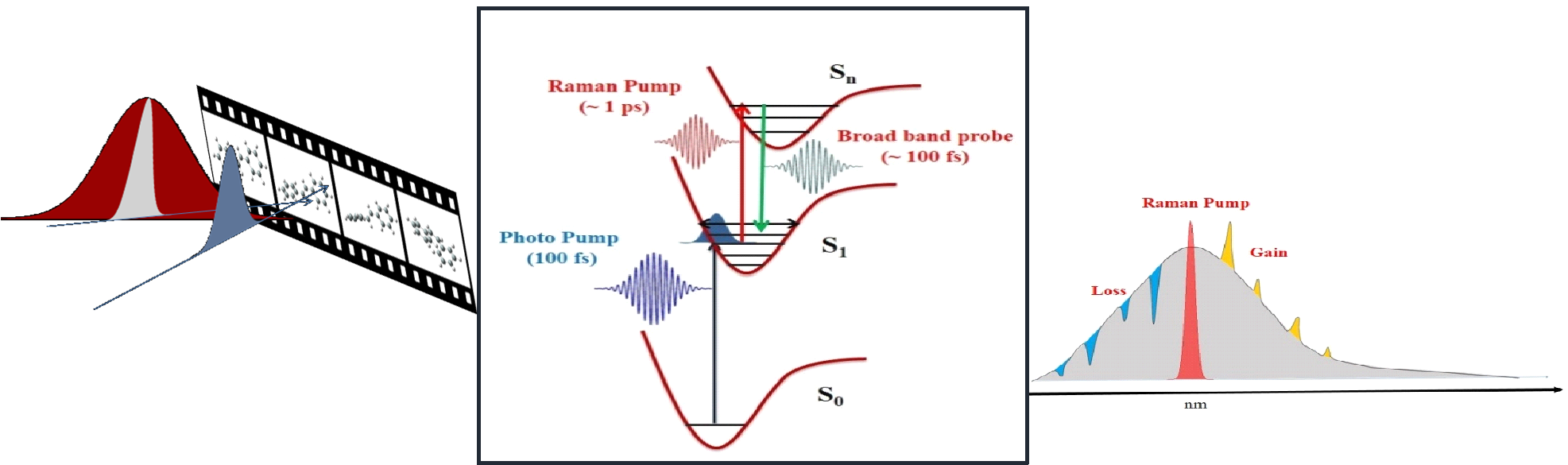
Ultrafast stimulated Raman has provided a new way to acquire vibrational signature of the transient species in a photochemical transformation. Using ultrashort pulses (100 femtoseconds) one can create and monitor transient structural change through nonlinear stimulated Raman technique. We have developed a new method to acquire vibrational Raman signature free from fluorescence background. Combining three optical pulses namely Photo-pump (100 fs), broadband probe (100 fs) and Raman pump (1 ps) and with sophisticated data acquiring method we could observe Raman signature of the short-lived species. By applying multiple ultrashort pulses to a molecular system we are able to detect loss signal at the anti-Stoke’s side. This spectroscopic technique is known as ultrafast Raman loss spectroscopy (URLS). We are currently studying ultrafast photo-isomerization, proton transfer and solvation effect in the excited state.
Grup Üyeleri
Yayınlar
Edit Publication
Projeler
Proje Bulunamadı
